
Samen Zob
Specialized Casting of Industrial & Mining Parts
Samen Zob
Specialized Casting of Industrial & Mining Parts
Samen Zob
Specialized Casting of Industrial & Mining Parts
In the world of engineering and industrial manufacturing, sand casting remains one of the most essential and widely used methods—even after thousands of years.Imagine molten metal heated to several hundred degrees being poured into a compacted sand mold, cooling, and transforming into a strong, precise component. From massive engine blocks to small ornamental parts, sand casting remains a foundational method due to its simplicity, flexibility, and ability to produce large and complex shapes. If you want to understand what casting sand is, how molds are made, and why major industries continue to rely on this technique, keep reading.
Sand casting is a simple, practical technique for shaping molten metal.
The molten metal is poured into a mold made of specially prepared sand.
After cooling, the final component takes shape with structural integrity and dimensional consistency.
Because sand is heat-resistant, affordable, and capable of capturing detailed geometries, this method is ideal for producing large, complex, or heavy parts such as pump housings, engine blocks, and industrial machine components.
In short: sand casting is an economical, repeatable, and highly versatile process for producing metal parts using sand molds.
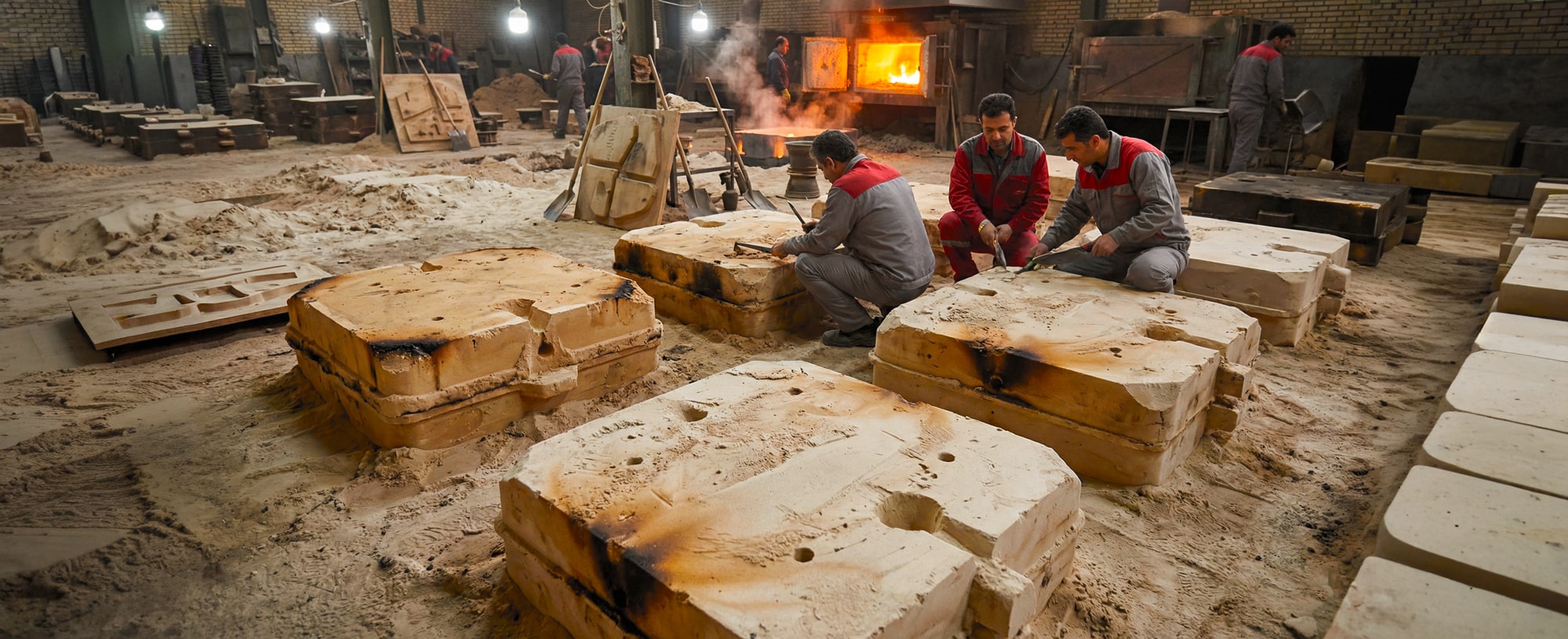
Sand casting is one of the oldest and most widely used metal-forming processes. The mold is created from special casting sand engineered to withstand high temperatures while capturing fine details of the part. Due to low tooling cost and design flexibility, it remains a top choice for producing large parts across many industries.
The origins of sand casting go back thousands of years when craftsmen used natural sand and clay to create molds.
Over time, sand compositions improved using additives like bentonite, silica, and advanced binders. Modern advancements in temperature control, ventilation, and material science keep sand casting at the foundation of industrial production.
Compared to investment casting or centrifugal casting, sand casting offers greater size flexibility and lower costs. Although newer methods provide higher dimensional accuracy, sand casting remains the primary method for producing large, heavy industrial components.
Selecting the correct sand grain size and additives ensures mold strength and dimensional accuracy.
The pattern is placed in a core box, sand is compacted around it, and the cavity forms through vibration and careful compaction.
• Wet molds → better for large parts with lower accuracy
• Dry molds → better for high-precision, heat-resistant components
Core boxes, wood or metal patterns, and shaping tools form the initial mold cavity.
Precision in pattern-making directly affects the accuracy of the final component.
Vibrators ensure uniform sand compaction, molding machines increase consistency, and furnaces prepare molten metal at controlled temperatures.
Labs test permeability, grain size, compressive strength, and moisture to ensure mold quality and reduce casting defects.
The part model is designed and the right alloy is chosen based on mechanical and performance requirements.
Sand is mixed with additives to improve bonding, strength, and heat resistance.
Sand is packed around the pattern, and cores are placed to create internal cavities.
Metal is melted at a controlled temperature and poured into the mold for optimal density and minimum porosity.
The mold is broken, the part is extracted, and finishing is performed including cutting gates, grinding, and quality inspection.
Green Sand Casting:
Uses moist sand; ideal for large components with low detail complexity.
Dry Sand Casting:
Combines sand with chemical binders; used for high-precision, heat-resistant parts.
Permanent-Mold Sand Casting:
Uses reusable metal molds with sand as a coating layer; suitable for high-volume production.
Mechanized & Automated Sand Casting:
Automated machines provide uniform sand preparation and high-speed production, improving quality and reducing human error.
Low cost, high versatility, simple process, ability to produce large and complex shapes.
Lower dimensional accuracy, rough surface finish, higher material consumption compared to modern casting methods.
Engine blocks, cylinder heads, gears, and multiple drivetrain components.
Used to manufacture heavy-duty components for tractors, mining machinery, and industrial equipment.
Yes—large housings, valves, pump bodies, and other massive components are commonly produced using this method.
Absolutely. Due to sand’s shapeability, it is widely used for sculptures, ornamental parts, and artistic metalwork.
Sand casting remains one of the most widely used methods for producing metal components due to its low cost, design flexibility, and ability to create large, complex parts. It is used in automotive, agricultural, mining, industrial, and artistic applications. With proper sand selection, moisture control, temperature accuracy, and defect inspection, manufacturers can ensure high-quality results. Companies like Samen Zob provide professional mold design, casting, melting, and finishing services—ensuring durable, precise, and high-performance components.