
Samen Zob
Specialized Casting of Industrial & Mining Parts
Samen Zob
Specialized Casting of Industrial & Mining Parts
Samen Zob
Specialized Casting of Industrial & Mining Parts
Investment casting is both an art and a science — enabling the production of metal components with exceptionally fine detail, precise geometry, and superior surface finish. This process allows industries to manufacture complex and sensitive parts with minimal post-processing while maintaining full control over dimensions and mechanical properties. Every part produced through this method represents a combination of accuracy, strength, and durability — a critical advantage across advanced industries such as automotive, aerospace, medical equipment, and precision machinery. If you want to understand how this technology can transform your product quality and production efficiency, keep reading.
Investment casting is a high-precision manufacturing process used to produce complex metal components with extremely accurate dimensions.
Unlike conventional casting methods that often require extensive machining, investment casting delivers near-net-shape results, meaning the initial cast part is already very close to the final design. This makes it ideal for manufacturing sensitive, specialized, and high-performance components.
The main difference between investment casting and traditional methods lies in dimensional control, surface quality, and the structural integrity of the metal.
Using specialized materials such as ceramic shells and high-purity industrial wax, this method ensures superior repeatability and accuracy.
Its importance across advanced industries is undeniable: from automotive and aerospace to medical devices and industrial tooling, investment casting is a foundational technology for producing long-life components that must meet strict international standards.
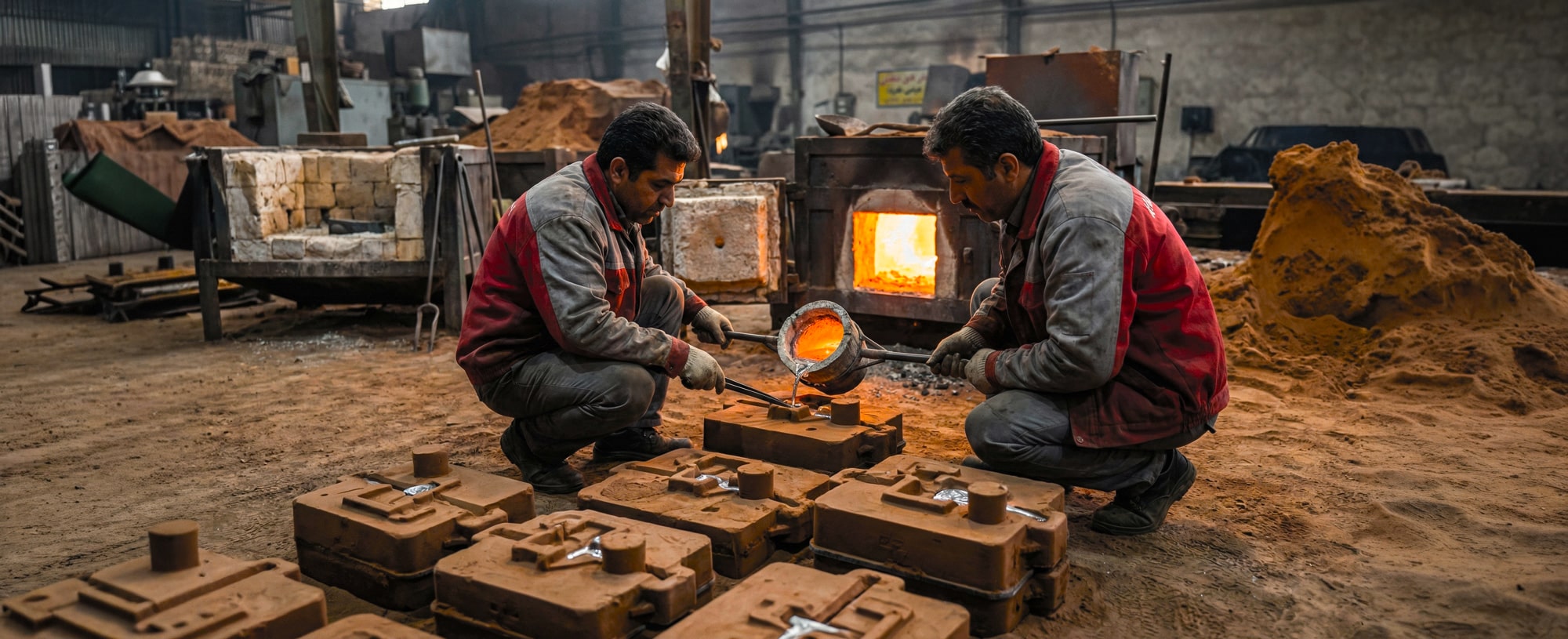
Parts manufactured through investment casting typically require little to no machining, making it ideal for high-precision industries such as aerospace and medical manufacturing.
Ceramic-shell and high-quality wax systems allow for the creation of intricate shapes and fine details that other casting processes cannot achieve.
Thanks to near-net-shape production, material waste is significantly reduced, operational efficiency increases, and production costs decline.
Modern equipment further improves consistency and mechanical performance.
High dimensional accuracy
A wax replica of the final component is created using high-quality industrial wax.
This model defines the quality and dimensional accuracy of the final part.
Types of wax: standard wax, blended wax, 3D-printing wax
Methods: wax-injection molding or 3D-printed wax patterns
(allows extremely fine details)
Wax patterns are assembled into a cluster called a “tree.”
Includes runner systems and gating design
Proper gating ensures smooth metal flow and prevents porosity
The assembled wax tree is dipped into ceramic slurry and coated with refractory sand.
Requires multiple layers
Each layer must dry completely to ensure shell strength and thermal resistance
The wax is melted out using autoclave or furnace systems.
Creates a precise cavity inside the ceramic shell
Firing improves shell strength and surface quality
The selected metal alloy is melted and poured into the preheated ceramic mold.
Furnaces: induction, electric, or gas
Critical control of melt temperature and alloy chemistry
After solidification:
Shell removal (knockout)
Shot-blasting
Surface finishing & machining
Dimensional and mechanical inspection
These steps ensure that every finished component meets industrial standards.
Sand Casting
Squeeze Casting
Centrifugal Casting
Investment casting provides superior detail, accuracy, and smoothness compared to all above.
future is shaped by:
This results in faster production, higher accuracy, and lower manufacturing costs.
A precision casting process using wax patterns and ceramic shells to produce near-net-shape metal parts with excellent surface finish.
Complex, intricate, high-precision components — turbine blades, engine parts, medical tools, etc.
Initial tooling cost is higher, but mass-production and reduced machining make it economical for medium-to-high volumes.
Typically ideal for small to medium components; size limits depend on shell strength and alloy weight.
Yes — once tooling is ready, repeatability is excellent and cost per part decreases.
Investment casting is one of the most advanced manufacturing methods for producing precise, complex, high-quality industrial components.
Its ability to minimize machining, reduce waste, and maintain consistency makes it ideal for aerospace, automotive, medical, dental, and precision-engineering applications.
For expert consultation, pricing, or production requests, contact our team to receive the optimal casting strategy tailored to your project.