
Samen Zob
Specialized Casting of Industrial & Mining Parts
Samen Zob
Specialized Casting of Industrial & Mining Parts
Samen Zob
Specialized Casting of Industrial & Mining Parts
When your components must perform reliably under the toughest conditions, squeeze casting becomes the ideal choice.
This advanced technique applies controlled pressure to molten metal, creating a dense, highly durable structure with exceptional mechanical performance and flawless surface quality. If you require top-level results for critical industrial applications, this process is exactly what transforms your product into a premium, high-trust solution. Your customers rely on quality—and squeeze casting delivers precisely that level of confidence.
Squeeze casting is one of the most advanced metal-forming methods used in both heavy and high-precision industries.
In this process, molten metal is poured into the mold and immediately subjected to high pressure. This compresses the internal structure, eliminates porosity, and ensures exceptional surface quality. The result: parts with superior strength, long service life, and extremely tight dimensional accuracy.
The core principle of squeeze casting is applying pressure to molten metal. This pressure forces out air bubbles and impurities, ensuring a dense, uniform structure.
The more precisely pressure is controlled, the higher the final strength, durability, and reliability of the component.
This makes squeeze casting the ideal method for high-performance industrial and automotive parts.
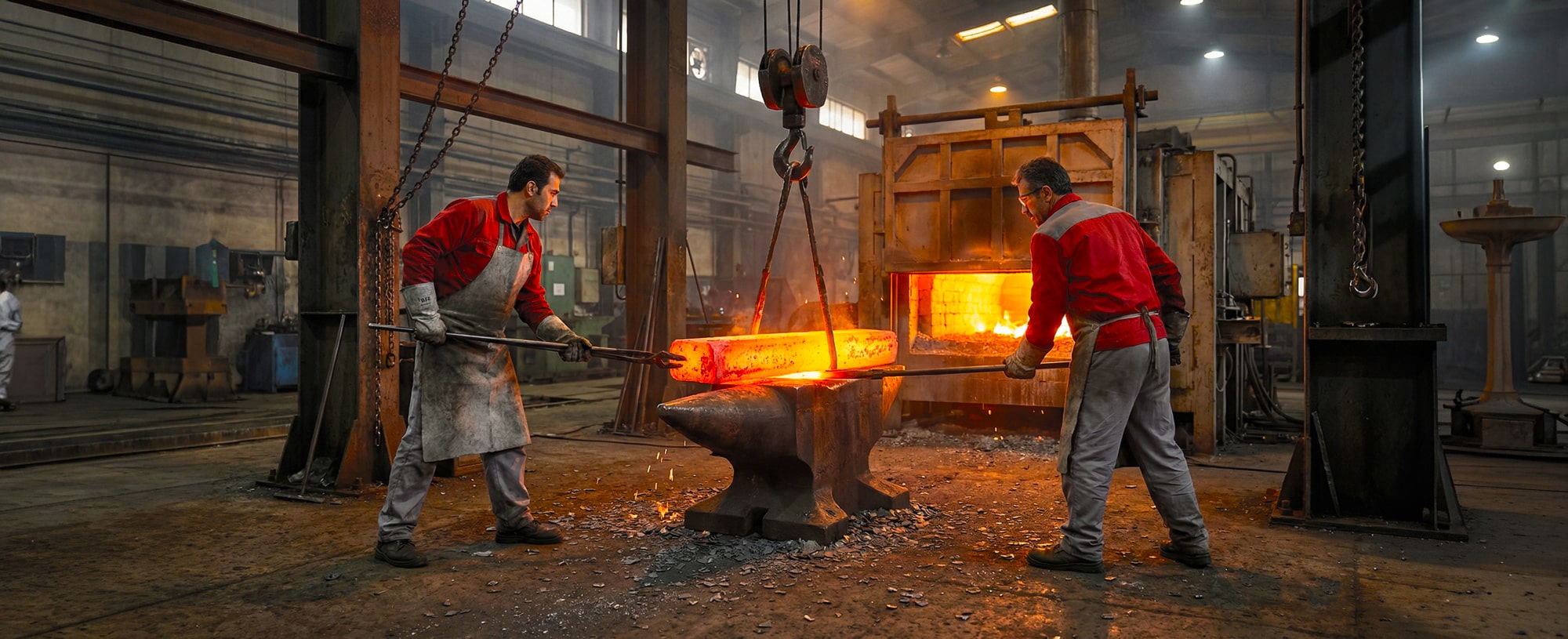
Steel molds must be completely clean and properly preheated to ensure accurate filling.
Meanwhile, the metal alloy is melted to an exact temperature to achieve the ideal viscosity for capturing all mold details.
Molten metal is poured into the mold and immediately compressed under high pressure.
This pressure removes air bubbles and impurities, resulting in a dense, strong, and uniform structure.
Precision and pressure stability are critical to preventing cracks or internal defects.
The component is cooled under controlled conditions to avoid internal stresses.
Once fully solidified, it is removed for finishing and final processing.
Molten metal is poured directly into the mold, and pressure is applied instantly.
Produces low-porosity, dimensionally accurate parts—ideal for automotive and advanced industrial components.
Metal is first poured into a separate chamber, then injected into the mold under pressure.
Suitable for large or complex parts requiring controlled flow and reduced defects.
Direct = better surface and dimensional accuracy
Indirect = better for large or complex components
Choosing the right method improves both quality and production economy.
Dense internal structure improves impact resistance, fatigue strength, toughness, and hardenability—allowing components to operate under heavy loads without failure.
Pressure removes air bubbles and prevents internal voids, resulting in stronger, tougher, more reliable components.
Reduced waste, faster cycle times, and minimal machining make squeeze casting more economical than forging or conventional mass-production.
HPDC focuses on speed; squeeze casting focuses on structural density.
Squeeze casting produces stronger, tougher parts with fewer defects.
Investment casting offers excellent detail, but mechanical strength is lower.
Squeeze casting provides high density and superior toughness.
Forging is strong but expensive with shape limitations.
Squeeze casting offers near-forged properties at lower cost and with better shape flexibility.
Squeeze casting is widely used in automotive (pistons, bushings, suspension arms), aerospace and defense (aircraft components, missile parts), and heavy industrial equipment (pump housings, blades). The dense structure increases durability, reduces weight, and improves performance.
Lightweight alloys allow steel components to be replaced with high-strength aluminum or magnesium—improving fuel efficiency and operational performance.
Lightweight, strong, thermally conductive—ideal for automotive, aerospace, and industrial machinery.
Proper alloy choice depends on operating temperature, load, corrosion resistance, machinability, and cost.
No. Squeeze casting focuses on pressurizing molten metal inside the mold for uniform density.
Liquid metal forging applies pressure for plastic deformation; surface quality and density differ.
Squeeze casting eliminates porosity through pressure; steel casting focuses mainly on molten steel flow and requires additional finishing.
Squeeze casting is ideal for precise lightweight parts; steel casting is ideal for heavy-duty components.
Yes—especially when quality, strength, and durability are critical.
However, mold and equipment cost must be considered for very small production runs.
Squeeze casting is a modern, high-precision method for producing dense, durable, and dimensionally accurate components.
From mold preparation to pressure application and controlled cooling, each step enhances mechanical strength and minimizes defects.
This method works effectively with both lightweight alloys and steel, offering a practical alternative to forging and traditional casting.
For high-quality industrial components at competitive cost, contact the expert team at Samen Zob to select the optimal squeeze-casting solution for your needs.