
Samen Zob
Specialized Casting of Industrial & Mining Parts
Samen Zob
Specialized Casting of Industrial & Mining Parts
Samen Zob
Specialized Casting of Industrial & Mining Parts
Copper casting bridges the gap between art and industry—transforming copper and its alloys into durable, precise, and uniquely elegant components. From sensitive industrial parts to decorative elements and advanced medical equipment, this process guarantees both quality and performance. If you want components that combine high strength with custom shapes and detailed geometry, copper casting is your optimal solution. In the following sections, you will learn about the methods, benefits, and industrial applications of copper casting—and how it can add real value to your products.
Copper casting is a process in which copper and its alloys are melted and poured into molds to create components with precise shapes and dimensions.
Because copper has excellent thermal and electrical conductivity, corrosion resistance, and good formability, this method is widely used across many industries.
Definition & Industrial Importance
This method helps produce industrial and decorative components with high accuracy while saving time and cost compared to many other manufacturing techniques.
It is highly useful in automotive, medical equipment, electrical systems, and construction industries.
History of Copper Casting
With thousands of years of history, copper casting was used since ancient times for tools, vessels, and jewelry.
Modern advancements—such as investment casting and high-pressure casting—now allow the production of complex industrial components with exceptional quality.
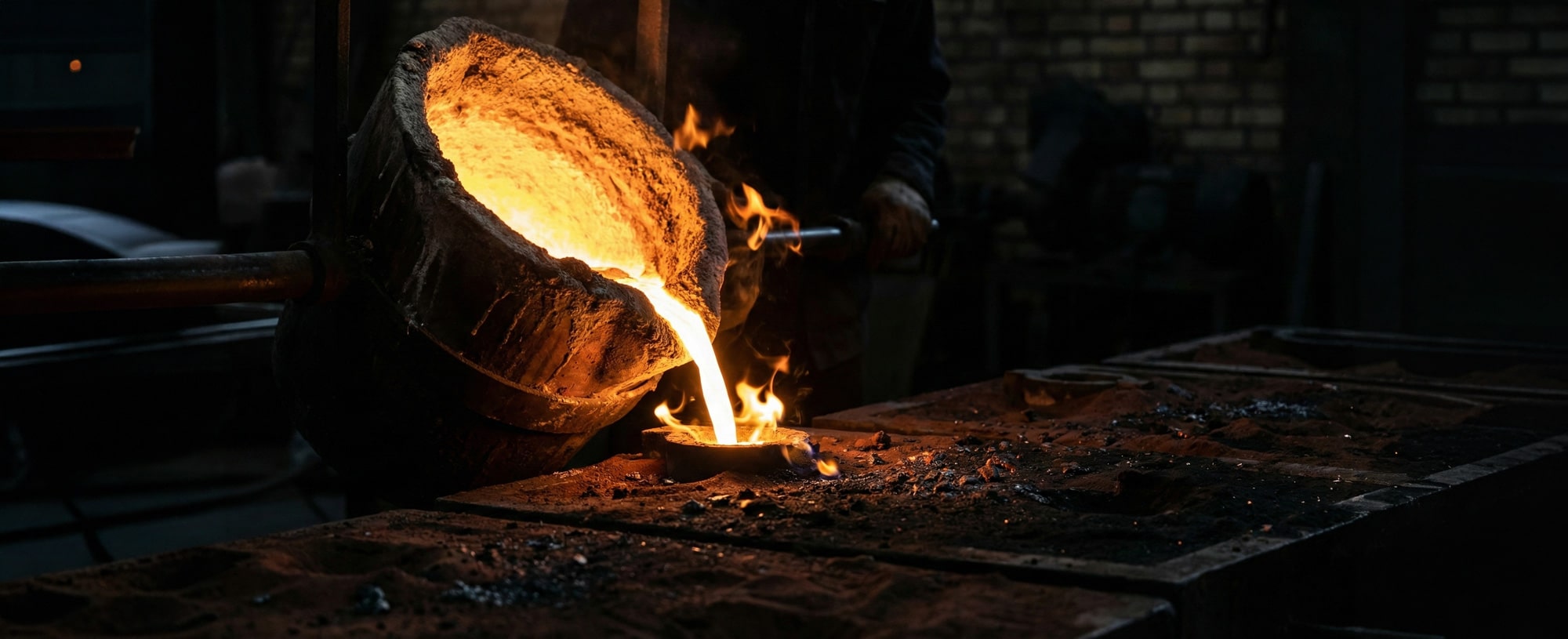
One of the oldest and most widely used methods.
The mold is strengthened with CO₂ gas, allowing molten copper to form medium-sized, complex components.
Due to its simplicity and low cost, it is heavily used in various industries.
The mold is made of thin layers of resin-bonded sand on a wax pattern.
This produces detailed, precise components with smooth surfaces—ideal for artistic and small to medium industrial parts.
Molten copper is injected into a metal mold under high pressure.
Perfect for industrial components requiring high accuracy, smooth surface, and excellent repeatability—widely used in automotive and industrial applications.
The mold rotates at high speed, and centrifugal force distributes the molten copper evenly.
Ideal for tubes, bushings, cylindrical components, and high-density industrial parts.
A wax model is made, coated with ceramic, and molten copper is poured in after the wax melts out.
This method produces extremely detailed, high-accuracy parts with excellent surface finish.
Every alloy has specific mechanical properties. Wrong selection can cause cracking, poor corrosion resistance, or dimensional deformation.
Choosing the wrong casting method increases waste and reduces quality.
Copper casting involves high temperatures and chemical fumes.
Proper ventilation, protective equipment, and waste-management prevent accidents and environmental damage.
Without hardness testing, pressure tests, dimensional inspection, and surface analysis, defective parts may fail during operation—leading to high maintenance costs.
One of the greatest advantages is the exceptional durability of cast copper components.
They remain stable under harsh conditions, high pressure, and exposure to corrosive materials—ideal for heavy industries and automotive applications.
Copper casting allows components with complex geometries, fine details, and variable dimensions that are difficult or costly to produce using other methods.
Professional companies—such as Samen Zob—ensure accurate alloy selection, mold design, proper melting temperature, and strict quality control, resulting in precise, long-lasting components.
Induction furnaces melt copper uniformly with precise temperature control, preventing unwanted chemical changes.
Auxiliary systems—temperature-control units, pouring vessels, safety equipment—ensure a stable and high-quality casting process.
Due to high molten-metal temperatures and harmful fumes, proper PPE, safe working distance, ventilation, and environmental standards are essential.
Cost depends on:
• alloy type
• part size & complexity
• desired accuracy
• casting method (sand, shell, die-casting, centrifugal, investment)
• finishing operations
• order volume
Small/simple parts are cheaper and faster; complex/high-precision parts require more time and advanced equipment.
Choosing a skilled provider ensures the best balance between cost and quality.
We manufacture copper components exactly according to your drawings, samples, and specifications.
Our engineering team selects the right alloy, designs the mold, and optimizes the process for durability and accuracy.
From melting to final inspection, every stage follows strict international standards.
It depends on part complexity, volume, and required accuracy.
Investment casting and die casting are best for detailed parts; CO₂ sand casting is ideal for larger shapes.
Costs vary by alloy, size, accuracy, mold type, and finishing requirements.
Through correct alloy selection, precise temperature control, proper mold design, and complete mechanical and surface testing.
If you need strong, precise, and fully custom copper components, now is the time to begin.
Our expert team is ready to recommend the optimal casting method, select the right alloy, and guarantee the highest quality at a competitive cost.