
Samen Zob
Specialized Casting of Industrial & Mining Parts
Samen Zob
Specialized Casting of Industrial & Mining Parts
Samen Zob
Specialized Casting of Industrial & Mining Parts
Cast iron casting is one of the most reliable and cost-effective methods for producing durable industrial components. With proper ordering, high-strength, wear-resistant, and dimensionally accurate parts can be manufactured for a wide range of industries. Because of its excellent mechanical properties, low production cost, and capability for mass-production, cast iron casting remains the preferred choice for major factories and heavy-industry sectors. If you need customized, high-quality cast iron components, our factory provides complete solutions—from mold design to final delivery.
Cast iron casting is an industrial process in which molten cast iron is poured into molds after melting at specific temperatures. This method—one of the oldest yet most precise forms of metal manufacturing—enables the production of durable components with excellent strength and accuracy.
Due to its high resistance, good mechanical stability, and ability to form complex shapes, cast iron is widely used in many industries.
From automotive components to mining equipment and agricultural machinery, cast-iron manufacturing forms a major foundation of today’s industrial production.
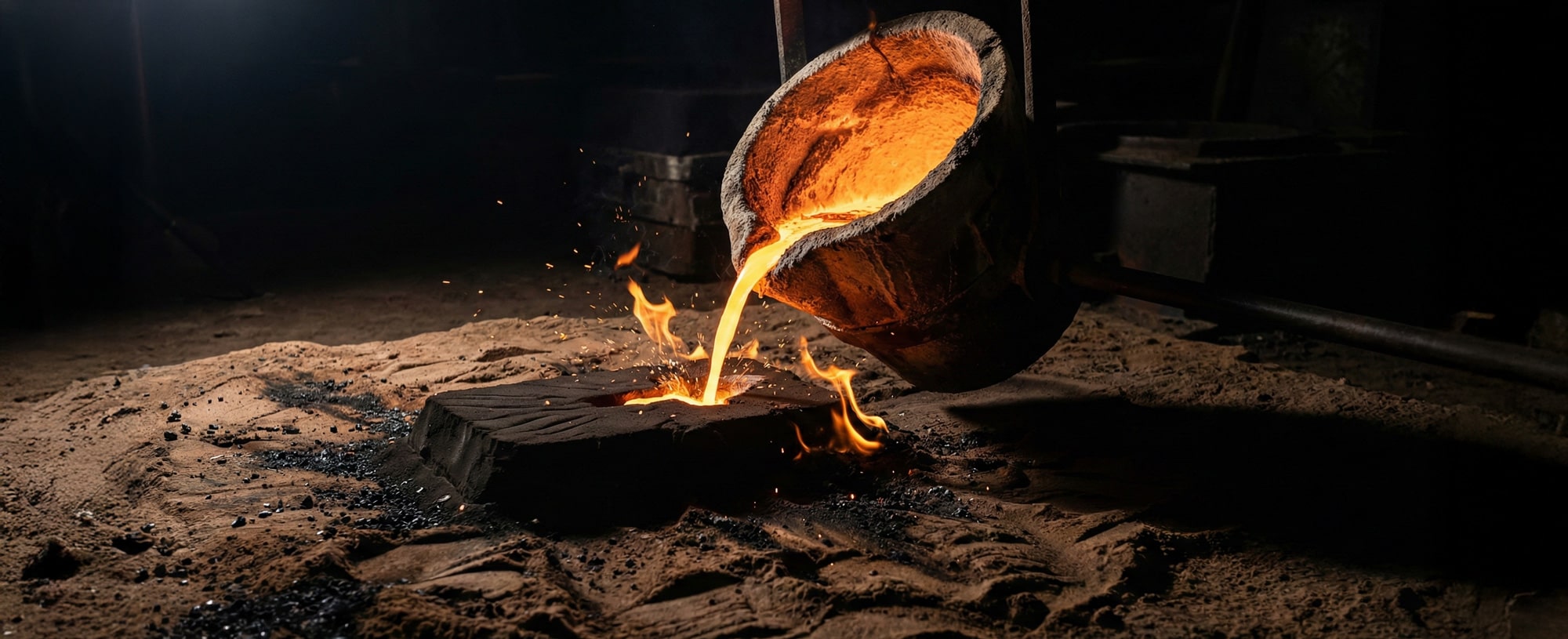
Cast iron casting is one of the most cost-effective industrial manufacturing methods.
Its low production cost and excellent mechanical performance make it superior to full machining or forging.
In high-volume production, unit cost decreases significantly while quality remains consistent.
Cast iron offers ideal melting temperature and outstanding mechanical strength, making it suitable for complex parts requiring durability and structural rigidity.
Cast iron can be shaped into intricate geometries with high dimensional accuracy—providing a major advantage over methods with shape limitations.
Cast iron components show exceptional performance in harsh operating conditions—resisting abrasion, pressure, impact, and mechanical vibration.
Gray iron, ductile iron, and alloy cast irons offer tailored strength, toughness, corrosion resistance, and heat stability depending on application needs.
Raw materials—scrap iron, steel, alloy additives—are precisely selected and melted between 1150°C and 1300°C.
Controlled melting ensures uniform chemical and mechanical properties, while advanced furnaces reduce impurities.
The molten metal is poured into cast-iron molds with extreme accuracy.
Mold type and design directly influence final dimensional accuracy and prevent casting defects.
The part undergoes controlled cooling, mold removal, trimming, cleaning, and quality inspection to ensure readiness for industrial use.
We manufacture cast-iron parts exactly according to your drawings and technical specifications to ensure compatibility with your production line.
Our engineering team designs and manufactures your custom molds to guarantee final dimensional accuracy and reliability.
We cast gray iron, ductile iron, and alloy cast iron in a wide range of capacities to meet the needs of heavy industries.
The most common method for a wide range of components; ideal for complex geometries and suitable for gray and ductile iron.
A foam pattern burns away upon contact with molten iron, allowing the production of highly detailed and complex components.
Used for small and medium parts requiring smooth finish and high accuracy. Suitable for precision alloy cast irons.
Metal molds allow high-volume production with excellent dimensional repeatability and lower long-term cost.
Cost depends on:
Higher volume reduces unit cost significantly.
For a precise quote, clients should provide part dimensions, weight, alloy type, and production quantity.
Expert consulting ensures optimized cost and performance.
Cracks, porosity, shrinkage, segregation, and surface irregularities—typically caused by incorrect melting temperature, timing errors, or poor materials.
Visual inspection, non-destructive testing (magnetic, ultrasonic), and mechanical tests such as hardness measurement ensure structural integrity.
Proper alloy selection, accurate mold design, controlled melting temperature, defect correction, and post-casting heat treatment significantly improve lifespan and performance.
Yes. Even single-unit or prototype orders can be produced with the same precision and quality as mass-production components.
Delivery depends on alloy type, mold complexity, and production volume.
Customers receive a detailed timeline at the beginning of the project.
Minimum weight and production quantity depend on casting type, but the factory can accept small-batch and low-volume orders.
Yes. Custom cast-iron molds are designed and manufactured by our engineering team according to client drawings and samples.
Ordering cast-iron casting services from our factory ensures the production of high-quality, dimensionally accurate, and durable components.
With advanced equipment, specialized engineers, and full adherence to international standards, your project will be delivered efficiently and reliably.
Submit your drawings and specifications to begin the process and benefit from expert consultation at every stage.