
Samen Zob
Specialized Casting of Industrial & Mining Parts
Samen Zob
Specialized Casting of Industrial & Mining Parts
Samen Zob
Specialized Casting of Industrial & Mining Parts
Modern casting has revolutionized the production of industrial components.
Using advanced technologies, it is now possible to manufacture metal parts with high precision, superior strength, and minimal waste.
This process has replaced many traditional methods and provides the capability to create complex and sensitive parts with exceptional accuracy.
If you want to know how modern casting can enhance quality, efficiency, and productivity in your production cycle, keep reading.
Modern casting is among the most advanced metal-forming technologies used in today’s industrial world.
Combining cutting-edge engineering, high dimensional accuracy, and advanced quality control, this method outperforms traditional casting on every level.
It increases product consistency, reduces manufacturing waste, and improves mechanical performance.
Using modern equipment, updated alloys, and fully controlled processes from melting to solidification, manufacturers can produce components that meet global quality standards—especially in industries such as automotive, aerospace, oil & gas, and medical technology.
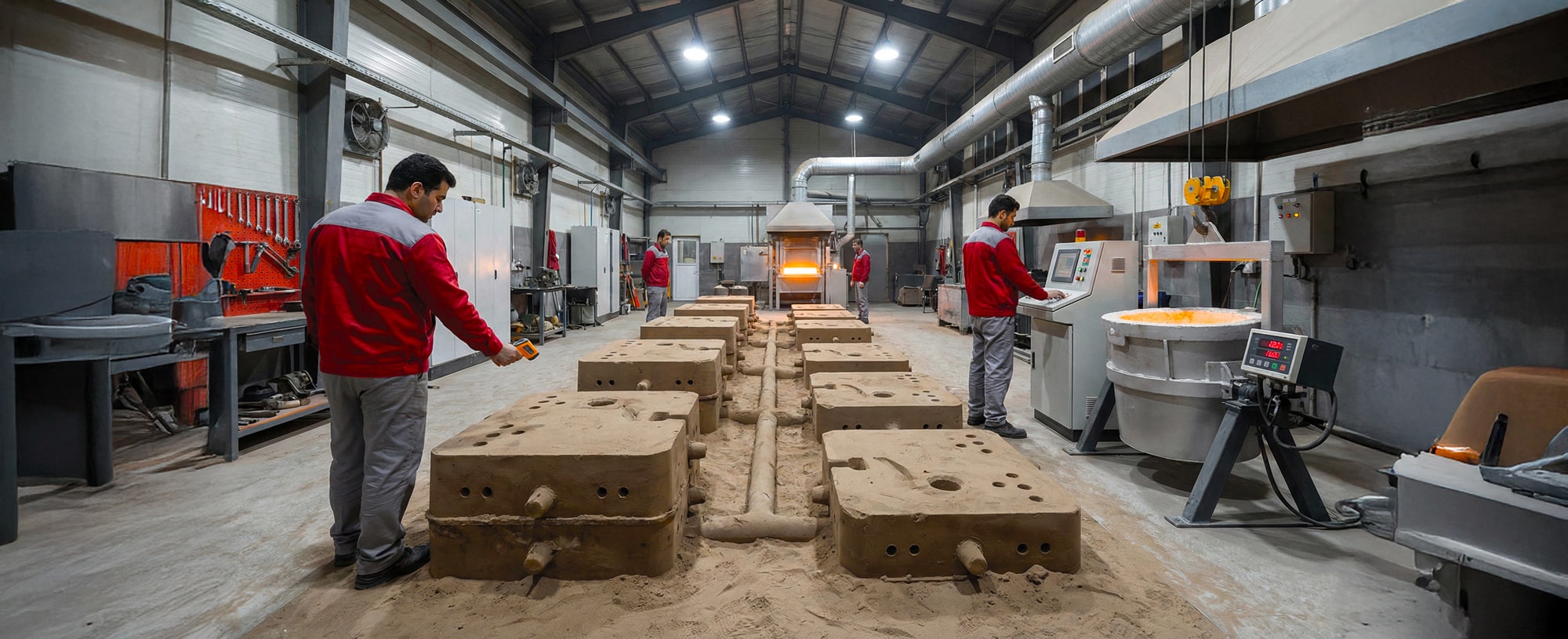
Modern casting uses advanced technologies such as 3D melt-flow simulation, digital temperature control, and engineered molds to produce defect-free components with exceptional mechanical properties.
Traditional methods rely heavily on manual control of melt temperature and solidification.
Modern casting uses automated systems that precisely control every parameter, resulting in lower defects, improved durability, less waste, and higher production efficiency.
Modern casting achieves higher accuracy, better surface finish, stronger mechanical properties, and reduced energy consumption compared to old methods. It is a cornerstone of modern industrial development.
Modern casting improves dimensional accuracy, mechanical strength, and reduces manufacturing costs through reduced scrap and optimized processes.
Modern casting is widely used in automotive engines, aerospace components, military equipment, and high-performance industrial machinery.
Faster production cycles, higher repeatability, and reduced energy consumption make modern casting a central technology in industrial advancement.
The process begins with selecting the right alloy based on mechanical and thermal requirements.
Advanced techniques ensure mold strength, dimensional accuracy, and improved surface quality.
Metal is melted and transferred to the mold under controlled conditions to minimize defects.
Controlled cooling increases mechanical strength and reduces internal stresses.
Machining, polishing, and extensive inspection ensure compliance with industrial standards.
Advanced casting facilities require significant investment and skilled operators. Without proper training, the risk of defects and production delays increases.
Additive manufacturing allows the creation of precision molds and complex geometries, reducing production time and improving design capability.
AI enhances process optimization, defect prediction, temperature control, and material efficiency—shaping the future of industrial casting.
A reliable casting provider must have advanced equipment, experienced engineers, and international quality certifications.
These elements ensure:
With modern equipment, high-quality alloys, and strict international standards, Samen Zob delivers durable, high-performance components for industrial applications.
Our team provides engineering advice, alloy selection guidance, and production optimization to meet your exact project requirements.
Modern casting uses advanced equipment, precise temperature control, and engineered molds to improve accuracy, durability, and surface quality.
Complex industrial parts, automotive components, military equipment, and heat-resistant or pressure-resistant components.
Based on alloy type, part size, mold complexity, casting method, and production volume.
Look for advanced machinery, experienced engineers, international quality standards, and strong technical support—attributes fully offered by Samen Zob.
Modern casting delivers high precision, improved strength, reduced waste, and increased production efficiency. Using advanced methods such as pressure die casting and centrifugal casting, industries can produce durable, complex components with superior mechanical properties. Choosing a professional company like Samen Zob ensures that every stage—from mold design to final inspection—is performed according to international standards.