
Samen Zob
Specialized Casting of Industrial & Mining Parts
Samen Zob
Specialized Casting of Industrial & Mining Parts
Samen Zob
Specialized Casting of Industrial & Mining Parts
In the world of advanced industries, manufacturing durable, high-quality components is always a major challenge. Industrial parts casting is a manufacturing solution that enables the production of strong, highly accurate, and cost-efficient components through tightly controlled processes.
This method allows you to produce parts with excellent mechanical strength, dimensional accuracy, and long service life—while reducing waste and production costs. If you’re seeking a reliable method for producing industrial components with exceptional quality, the following content will clarify all key principles, advantages, and applications of this process.
Industrial parts casting is a high-precision manufacturing process in which molten metal is poured into engineered molds. Through controlled temperature, pressure, and timing, the metal solidifies into a dense, uniform structure with high durability and dimensional accuracy. This method enables industries to produce strong, long-lasting components that meet strict performance requirements in automotive, aerospace, and industrial systems—often replacing traditional methods such as forging or classical casting.
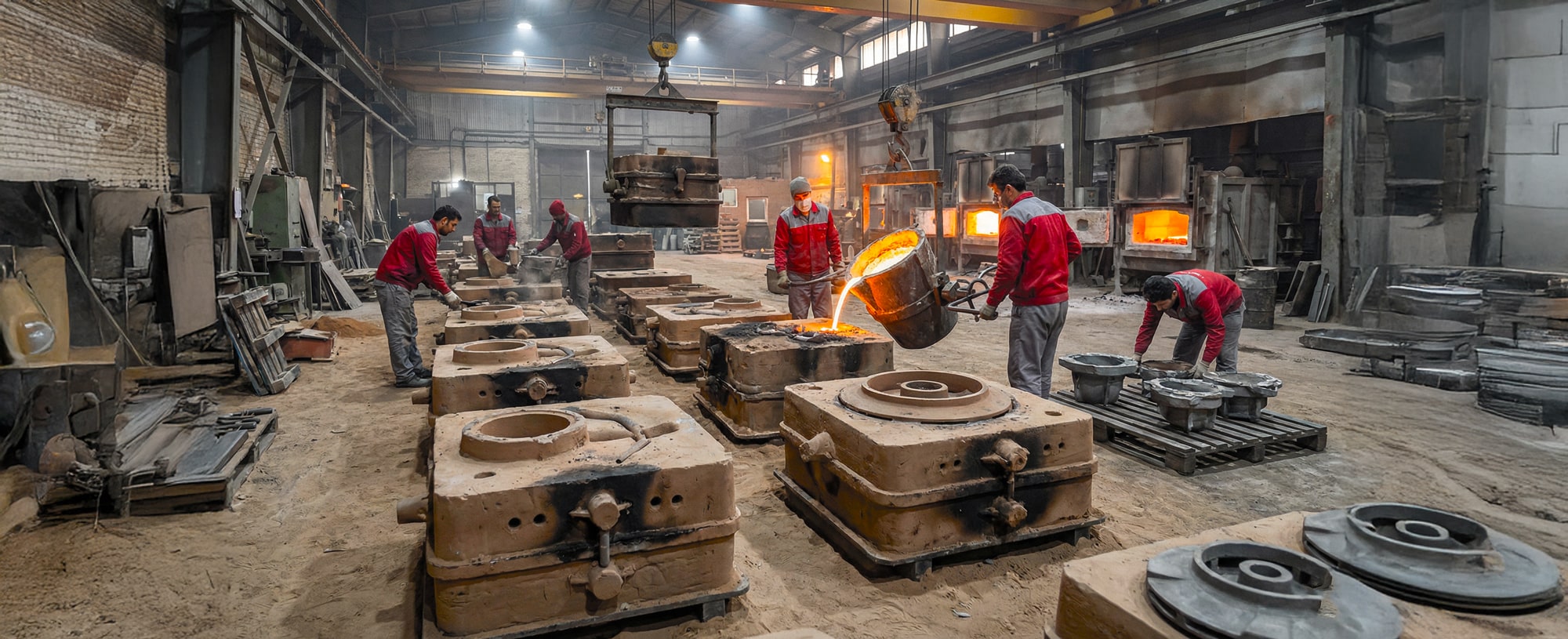
Controlled temperature and pressure prevent porosity and create strong, dense components with consistent performance.
Reduced waste, optimized material usage, and fewer machining operations make the process cost-effective.
Allows manufacturing of complex parts with excellent dimensions—without heavy machining.
Compatible with a wide range of alloys—from aluminum and magnesium to cast steel and stainless steel.
High strength, reduced cost, fast mass production, and ability to create complex geometries.
Requires precise temperature control; mold limitations; defects may occur without proper quality assurance.
Casting is cheaper and faster, but for ultra-precise components with very tight tolerances, forging and CNC machining still have advantages.
Ideal for large components; simple and low-cost but less accurate than advanced methods.
Suitable for small, complex parts with smooth surfaces and uniform structure.
Produces lightweight, strong components with excellent thermal conductivity for automotive and aerospace applications.
Best for limited-run or special-design parts requiring exact shapes and fine detail.
Ideal for high-strength, wear-resistant, and high-temperature components in heavy industries.
Excellent for lightweight parts requiring thermal conductivity and good machinability.
Alloy choice depends on pressure, temperature, corrosion, and mechanical strength requirements.
Alloy type and raw material cost
Component size and complexity
Production quantity
Required finishing and machining
Quality-control standards
Mold preparation time
Delivery time depends on:
• mold preparation
• casting cycle
• finishing operations
• inspection stages
Optimizing alloy choice, mold design, and production method reduces cost and improves overall efficiency.
A professional supplier must have international quality standards and certifications to ensure compliance with safety and performance requirements.
Advanced inspection tools and precision measurement systems improve quality control and prevent internal defects.
With years of experience in industrial casting, Samen Zob has executed diverse projects in automotive, heavy machinery, energy, and defense sectors—delivering consistent performance and reliability.
Cost varies based on alloy type, part size, mold complexity, and required precision.
Casting is faster and more economical for complex shapes; CNC is better for ultra-precise, tight-tolerance components.
Depending on mold type and method, production can range from single units to mass-production batches.
Yes—industrial casting supports intricate geometries and custom designs for high-performance applications.
Industrial parts casting is a precise, cost-effective solution for manufacturing strong, complex, and lightweight components across automotive, aerospace, oil & gas, machinery, and defense industries. Choosing the right alloy and casting method ensures long service life and optimized performance. For high-quality industrial components at competitive cost, contact our experts at Samen Zob to begin your project with confidence.