
Samen Zob
Specialized Casting of Industrial & Mining Parts
Samen Zob
Specialized Casting of Industrial & Mining Parts
Samen Zob
Specialized Casting of Industrial & Mining Parts
Custom parts casting is a precise and professional method for producing metal components with any desired shape and dimensions. This process makes it possible to manufacture durable, high-quality parts tailored for various industries.
Custom casting offers high flexibility and allows selecting the most suitable metal based on the technical and environmental requirements of your application. Continue reading to explore its advantages and industrial applications.
Our custom casting services include mold design, mold fabrication, production, and full quality supervision throughout all stages. Our objective is to provide high-quality components with precise dimensions and excellent durability for a wide range of industries—from automotive to heavy machinery. Depending on your project requirements, we select the optimal casting method and the most suitable metal alloy to maximize performance and service life.
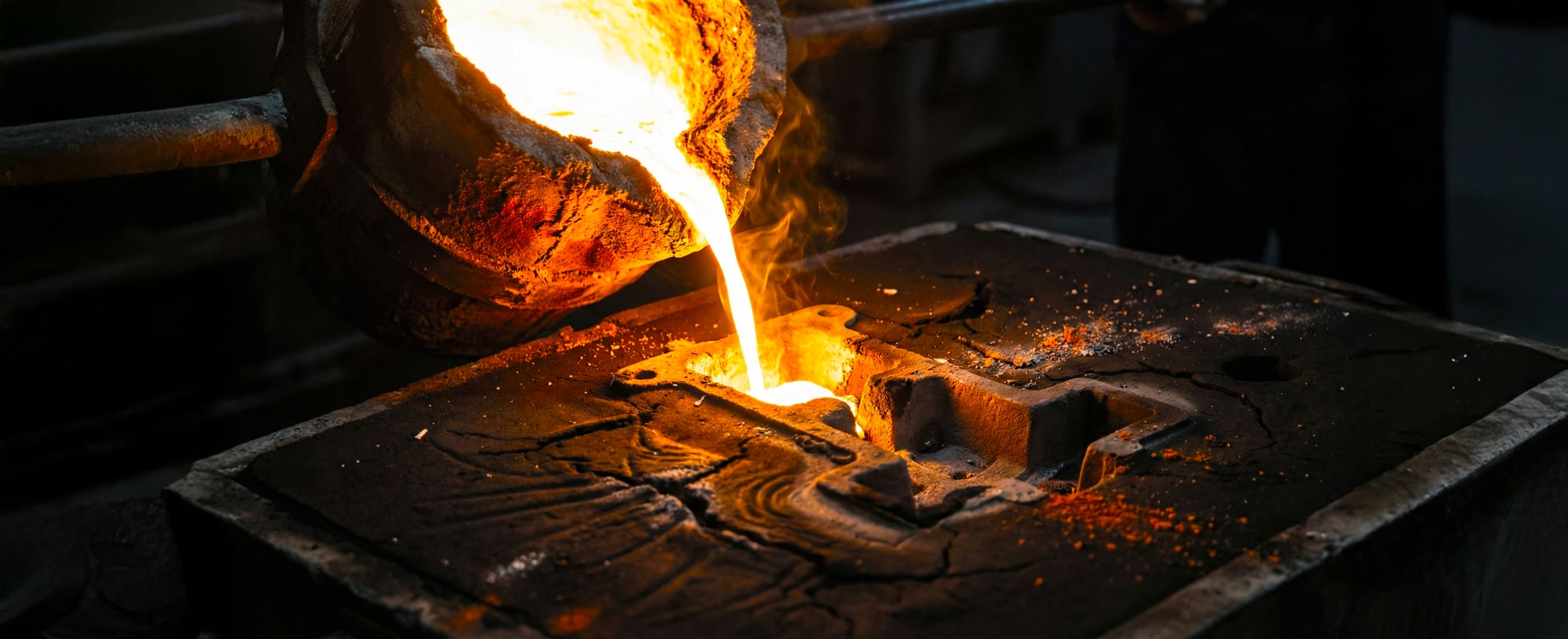
Disposable or sand molds are ideal for producing complex or unique parts with high accuracy and moderate cost. They are suitable for prototypes and low-volume production, offering fast turnaround and flexibility for design revisions without high upfront investment.
Permanent molds are used for mass production of industrial components with consistent quality and long mold life. They reduce waste, increase production speed, and ensure precise, repeatable dimensions—ideal for components requiring high durability and mechanical strength.
Custom casting enables you to define exact dimensions, alloy composition, and mechanical properties.
This improves performance, reduces maintenance costs, and makes the process economically efficient—especially for complex parts that cannot be manufactured through other methods.
Different casting methods are used depending on environmental conditions, mechanical requirements, and application needs. Choosing the right process ensures optimal performance and longer component lifespan.
CAD/CAM and simulation technologies enable precise mold design and accurate prediction of metal-flow behavior—minimizing errors and improving component quality.
Using heat-resistant, corrosion-resistant, and high-strength alloys allows manufacturers to produce high-performance parts suitable for demanding environments.
Modern casting methods reduce energy consumption and material waste, making the process more economical and environmentally friendly.
Sensors and digital monitoring ensure every component meets dimensional and mechanical standards from start to finish.
Almost any industrial part with complex shape or precise dimensions can be produced—flywheels, pulleys, gears, heavy-machinery parts, blower housings, and more.
Custom casting offers unmatched flexibility for specialized or high-performance components.
Applied to improve mechanical strength, durability, and resistance to deformation in cast components.
Specialized welding restores damaged cast components, extending service life and reducing waste and replacement costs.
Allows accurate reproduction and optimization of old or complex parts—ensuring compatibility, improved performance, and high manufacturing accuracy.
Custom casting is widely used in automotive, heavy machinery, industrial equipment, and air-handling systems. Proper alloy selection, heat treatment, and mold design improve component lifespan, performance, and reliability—especially for high-load and high-precision parts.
Heat treatment enhances mechanical strength, hardness, and structural stability, allowing cast components to perform reliably under harsh industrial conditions.
Specialized welding restores damaged or worn cast parts, extending service life, preserving dimensional accuracy, and preventing unnecessary replacement costs.
Reverse engineering enables accurate reproduction and performance optimization of complex or outdated components. Redesign ensures improved precision and compatibility with modern industrial requirements.
Custom casting is a process for shaping molten metal into precise industrial components. It is used for producing complex, durable parts in automotive, machinery, and other high-performance industries.
Cast iron, aluminum, steel, bronze, and brass are commonly used. The choice depends on performance requirements such as strength, corrosion resistance, and operating temperature.
Custom casting is designed exactly according to customer requirements—dimensions, alloy selection, mechanical properties—while standard casting is meant for mass production with predefined specifications.
Depending on mold type and alloy, parts can range from a few centimeters to several meters, offering excellent flexibility for various industrial applications.
Through proper alloy selection, precise mold design, temperature control, post-casting operations, and comprehensive quality inspections.
Typically between 1 to 6 weeks depending on size, complexity, alloy type, and casting method.
Submit your request for custom casting today and benefit from our high-precision, durable industrial components. Our expert team provides free consultation on alloy selection, mold design, and optimal casting methods to match your needs. With a simple call or form submission, you can begin the process of producing high-performance, long-lasting industrial parts.