
Samen Zob
Specialized Casting of Industrial & Mining Parts
Samen Zob
Specialized Casting of Industrial & Mining Parts
Samen Zob
Specialized Casting of Industrial & Mining Parts
Steel casting is one of the fundamental and essential processes in modern manufacturing, enabling the production of strong, precise, and complex components at an optimized cost. From small workshops to large industrial projects, steel casting plays a crucial role across multiple sectors. With advancing technologies, this process continues to improve in accuracy, efficiency, and product quality. By selecting the right casting techniques and leveraging modern equipment, manufacturers can produce durable, high-performance parts with long service life—helping industries increase productivity and reduce overall costs.
Steel casting is a widely used metallurgical process in which molten steel is poured into specially designed molds to form industrial components with precise shapes and dimensions. Thanks to its high strength, ability to form complex geometries, and excellent durability, steel casting is utilized heavily in heavy industries and high-demand engineering environments.
In addition to carbon and alloyed steels, stainless-steel casting is also used where corrosion resistance and high accuracy are required—such as shafts, pumps, valves, turbines, and industrial machine parts.
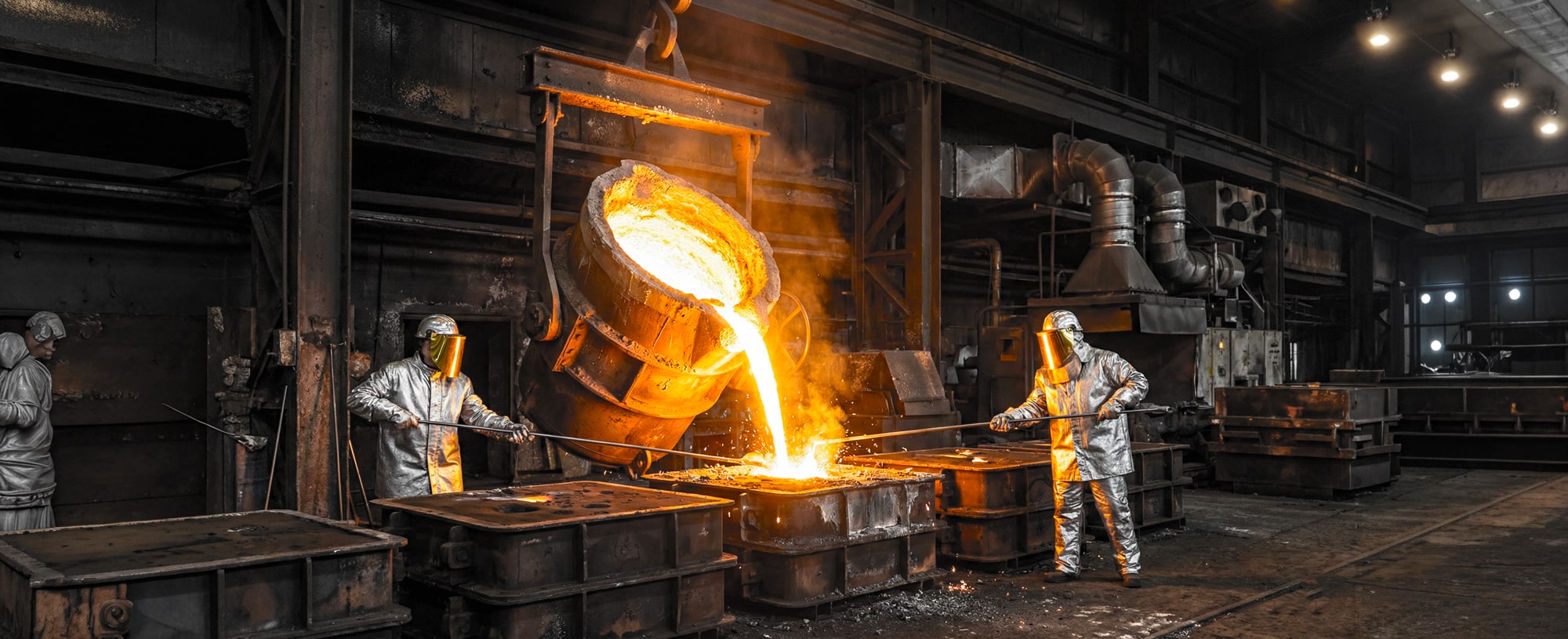
The chemical composition of cast steel varies depending on application requirements but typically includes iron, carbon, manganese, silicon, and additional alloying elements. The exact ratio of each element determines mechanical behavior.
Low-carbon steels offer high ductility, while high-carbon steels provide greater hardness and wear resistance.
Selecting the right mixture improves strength, durability, and performance of the final part.
Cast steels can be classified into several major groups: carbon steel, alloy steel, stainless steel, heat-resistant steel, and wear-resistant steel—each offering unique properties and applications.
Carbon steel is commonly used due to its simple composition, affordability, and high resistance to pressure and impact.
Alloy steel includes elements such as chromium, nickel, molybdenum, manganese, and vanadium—offering exceptional resistance to heat, corrosion, and wear. Ideal for gears, precision tools, pressure components, and mechanical assemblies.
Designed for extreme abrasion environments using alloying elements like chromium and manganese.
Used extensively in mining, cement, steel plants, and heavy machinery.
Stainless steel contains high chromium content that forms a protective oxide layer, preventing rust and corrosion.
Used in food processing, medical equipment, petrochemical systems, and water-treatment applications.
Heat-resistant steels contain chromium, nickel, and molybdenum, enabling performance above 1000°C without deformation.
Used for furnace parts, steel-industry equipment, molds for other metal castings, and thermal systems.
The complete workflow includes raw-material preparation, melting, pouring, cooling, part removal, heat treatment, machining, and inspection.
The ideal method depends on component size, accuracy, production volume, and cost.
Sand and investment casting are ideal for complex parts, while continuous casting and permanent molds suit mass production.
Standards such as ASTM, DIN, EN, and ISO define chemical composition, mechanical properties, quality control, and inspection procedures, ensuring durability and reliability.
Essential equipment includes controlled-temperature furnaces, durable molds, cranes, cooling units, cleaning machines, and inspection devices—each critical to product quality and defect reduction.
Steel casting is widely used in oil & gas, petrochemical, automotive, machinery, railway, heavy-equipment manufacturing, and power plants due to its strength, wear resistance, and durability.
Yes. One of its key advantages is the ability to produce large and heavy parts
Based on metal type, weight, casting method, mold complexity, and required accuracy
Oil & gas, petrochemical, steel manufacturing, machinery, and power-generation industries
Yes, but single-unit production usually has higher cost than mass production
Steel casting remains one of the most critical industrial methods for producing high-strength, durable components. Despite higher initial costs, it provides excellent reliability, long service life, and broad application across modern industries. For custom orders, contact our specialists to select the optimal casting method and ensure maximum quality throughout the production process.