
Samen Zob
Specialized Casting of Industrial & Mining Parts
Samen Zob
Specialized Casting of Industrial & Mining Parts
Samen Zob
Specialized Casting of Industrial & Mining Parts
Imagine your industrial stainless-steel components being manufactured with flawless precision — accuracy measured in millimeters, delivering the durability and performance your products rely on.With advanced steel-casting technologies, you can produce highly accurate and durable components, from widely used grades such as 304 and 316 to specialized alloys like Alloy 20.
But why can’t every steel-casting facility achieve this level of quality?
In the following sections, you’ll discover the principles and details behind the steel-casting process — insights that distinguish ordinary components from truly exceptional industrial products.
Steel casting is one of the core processes used to manufacture high-quality industrial components, playing a vital role in sectors such as oil & gas, automotive, medical equipment, and heavy machinery. This method enables the production of parts with excellent mechanical strength, heat resistance, corrosion resistance, and reliable dimensional accuracy — making it indispensable in modern industrial manufacturing.
Definition of the Steel-Casting Process
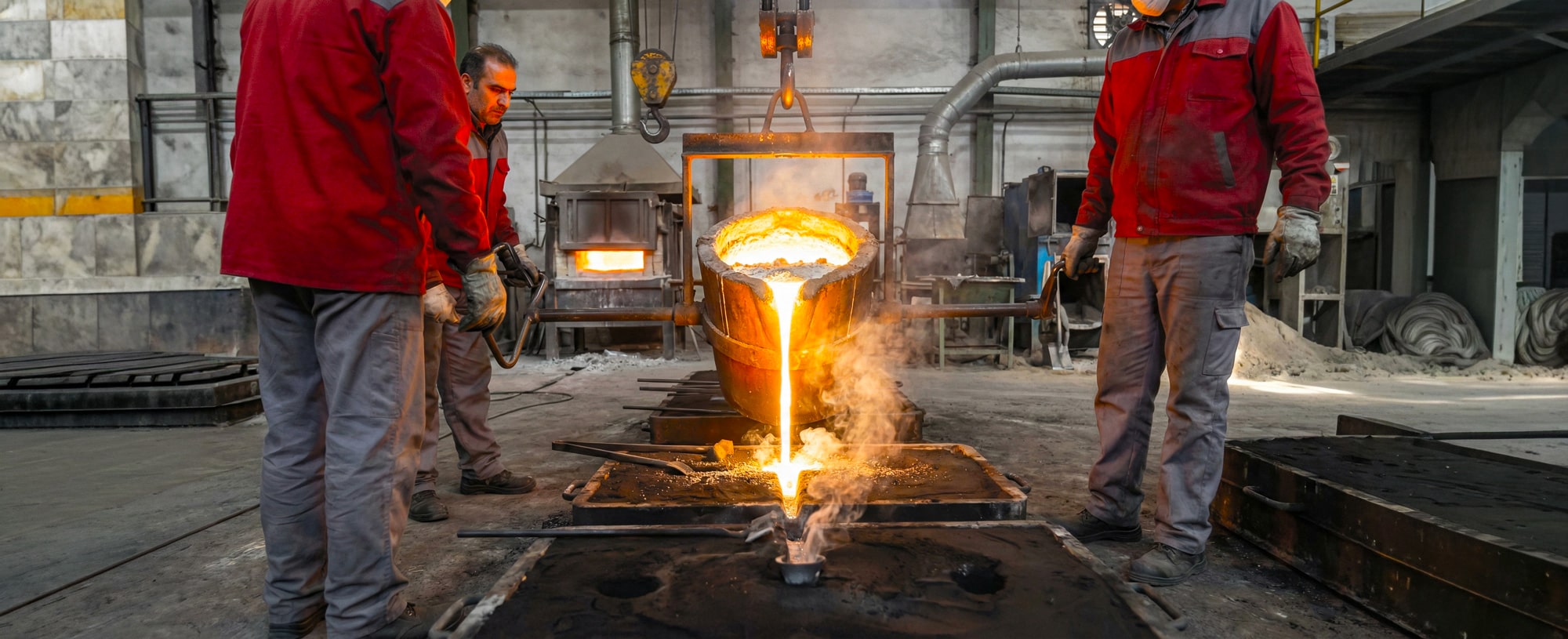
Steel casting is a process in which molten stainless steel is poured into engineered molds to solidify into components with precise shapes and dimensions. Control over melt temperature, cooling rate, and mold quality is crucial — even the smallest deviation can result in defects in the final product. Advanced investment-casting techniques allow for high dimensional accuracy and minimal waste.
Stainless-steel grades such as 304, 304L, 316, 316L, 321, and Alloy 20 are commonly used, allowing components to operate reliably under harsh industrial conditions.
Why Steel Casting Matters
Steel casting in Tehran and other industrial regions maintains an essential role due to the inherent advantages of stainless steel:
corrosion resistance, thermal stability, and mechanical strength. For this reason, many industries rely on grades such as 304L stainless steel to ensure durability and long-term performance.
Stainless Steel 304 / 304L — Properties & Applications
304 and 304L are among the most widely used casting alloys due to their exceptional corrosion resistance, long service life, and cost efficiency.
They are used in:
Ideal for humid or corrosive environments.
316 and 316L provide excellent resistance to aggressive chemicals and chlorides, making them suitable for:
321 stainless steel offers superb oxidation resistance and thermal stability, suitable for components exposed to sustained high temperatures.
Alloy 20 is engineered for superior resistance to acids and chemically aggressive environments.
It is widely used in chemical-processing equipment, pumps, valves, and long-life corrosion-resistant components.
The cost of steel casting depends on alloy selection, part complexity, production volume, and casting method.
Professional facilities with modern equipment ensure consistent quality, transparent pricing, and accurate delivery schedules.
To register an order, specify alloy, dimensions, tolerances, and submit through online forms or direct consultation.
Grades 316, 316L, and Alloy 20 are used to manufacture corrosion-resistant and heat-resistant components capable of performing reliably under harsh operating conditions.
Grades 304 and 304L offer hygienic properties and excellent corrosion resistance, ideal for tanks, sanitary pumps, and food-processing systems.
321 stainless steel and Alloy 20 are used for components requiring long-term resistance to high temperature and chemical exposure.
Steel casting offers high dimensional accuracy, the ability to produce complex geometries, corrosion resistance, and cost-efficiency in medium-to-high-volume production.
Higher tooling costs, need for precise temperature control, and sensitivity to alloy chemistry are primary limitations — all of which can be minimized in professional facilities.
The cost of steel casting depends on several key factors, including the alloy type (such as 304, 316, or Alloy 20), the complexity of the geometry, dimensional tolerances, the chosen casting method, and the production volume. Understanding these variables helps industries plan their budget efficiently and ensure they receive the best quality-to-cost ratio.
If you are seeking steel-casting services in Tehran, it is essential to work with a professional and well-equipped facility. Certified manufacturers with modern machinery, skilled technicians, and extensive experience can produce stainless-steel components that meet strict industrial standards.
These facilities offer accurate scheduling, transparent pricing, and the ability to track orders throughout the production process.
Using a reputable steel-casting provider ensures consistent quality, reduces the risk of production defects, and simplifies delivery and project management. To place an accurate order, define your required alloy, part dimensions, tolerances, and performance specifications.
Then submit your request through online forms or direct consultation to receive a detailed quotation, production schedule, and technical recommendations.
At Samen Zob, we design and manufacture high-precision stainless-steel casting molds using advanced equipment.
This ensures superior dimensional accuracy, smooth surface quality, and reliable mold performance. Prototype production allows clients to verify dimensions, surface finish, and structural integrity before mass production begins.
We produce stainless-steel components in various sizes for industries such as petrochemical, oil and gas, food processing, construction, and mechanical systems. Both serial production and project-based manufacturing are supported, ensuring every client receives components tailored to their technical and operational requirements.
After production, components are securely packaged and shipped across the country. Our technical support includes post-delivery assistance, troubleshooting, quality assurance, and specialized guidance to ensure long-term performance and customer satisfaction.
Depends on environmental conditions, corrosion factors, and temperature requirements.
Standard delivery: 2–6 weeks, longer for large or complex parts.
Mold accuracy, melt-temperature control, alloy chemistry, proper cooling, and advanced inspection.
Typically ideal for small-to-medium components; size limits depend on shell strength and alloy weight.
Yes — once tooling is ready, it offers excellent repeatability and consistent quality.
Steel casting combines advanced technology, engineering expertise, and strict quality control to deliver high-precision, high-strength components. Samen Zob ensures reliability, accuracy, cost-efficiency, and full support from mold design to final delivery.